It takes two for a tango. And it takes two classes for capitalism to dance - capitalists and workers. Much focus has been put on the fact that wages have to be above subsistence for the working class - and thus capitalism - to function. Less attention has been given to the critical level of capitalist consumption for the capitalist class to survive. Untill now.
What happened around 1980?
In an intriguing new article Nicolas Villarreal demonstrates that the capitalist class experienced a near-death event around 1980 and was only saved by the neoliberal turn.
The capitalist class is dependent on both wealth and profit to run. With a profit rate of 20% the average American income of $67.000 can be achieved with a capital of $0.34 million. But if the profit rate is only 3% then $2.1 million is needed. Based on historical profit rates Villarreal draws this chart:
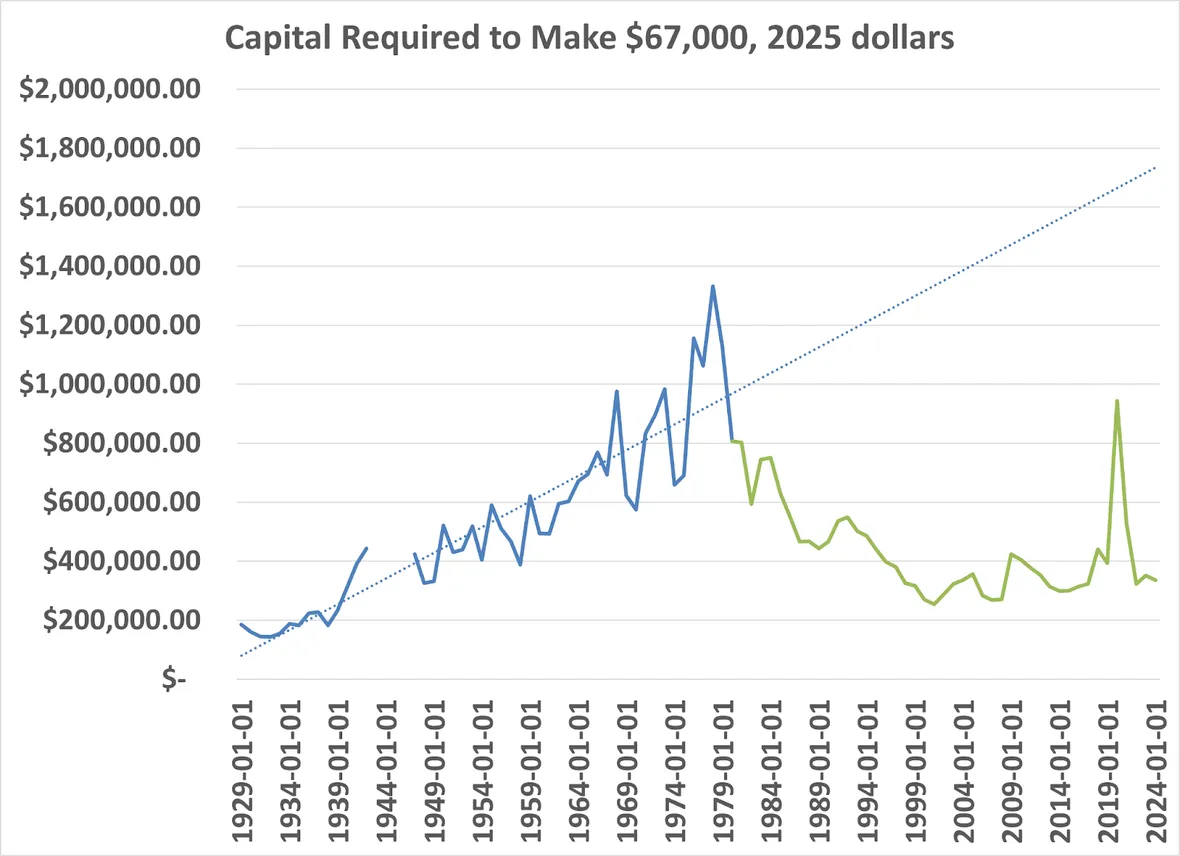
As the level of development rises increasingly fewer people will have the means required to start a business and become a capitalist. Over time newer and more expensive technological equipment and more extensive and complex business organisations are neccessary to break even. The entry barriers move higher and higher as consolidation and monopolization of industry grows.
This was the ’normal’ development of capitalism - up to around 1980. Capitalism’s growth logic followed this schema: rising investment rates → falling profit rates → shrinking capitalist class → increasing state control of investment.
When the capital requirement touched $1.0 million the capitalist mortality reached fatal levels - only the fattest cats survived capitalism’s own logic. The death knell turned into a scream for salvation - and it came with neoliberalism. Neoliberalism preserved the capitalist consumption rate, and thus protected the reproduction of the capitalist class as a whole.
For nearly half a century neoliberalism has succeeded in softening the consequences of capitalism for the capitalists not least by means of growing debt and venture capital.
However, rescuing the capitalist class through increased capitalist consumption was accommodated by relaxed investment rates. Thus neoliberalism undermined economic growth for a generation.
What happens now?
Now the old logic is starting to bite once more, with average firm size growing again. The highly competitive Chinese economy is becoming the global norm and the West the aberation. In contrast to the American approach, Chinese finance has been focused on funding infrastructure investment, and investment in industry. China practises a hyper-competitive scheme with delayed capitalist consumption that produces a “losing class” of failed capitalists.
Villarreal consider this losing class a ‘structural neccessity’ (in order to prevent emergence of monopoly capitalism in China). So much as neoliberalism kept these losers alive, now Chinese state capitalism will do the same - even though thy really are an adversarial force. Today the logic of capital has only one personification: the Chinese Communist Party - and the contradictions live on. There is no signs yet of following-up on capital’s own logic by fully eliminating the capitalist class and construct an economic system not based on private property.